The AI Self-Directed Learning Framework (ALTER) and FDE: Sustainable Growth for Software Engineers in the AI Era
The AI Self-Directed Learning Framework (ALTER) and FDE: Sustainable Growth for Software Engineers
💡 Executive Summary
"Human and AI intelligence operate on fundamentally different principles. Humans define real-world problems and set direction (Why & What), while AI excels at deep reasoning and execution across vast knowledge spaces (How). For two distinct forms of intelligence to collaborate effectively toward a shared engineering goal, they need explicit interaction protocols and guardrails. The ALTER framework serves as that collaborative harness. Built upon this foundation, the execution model of the Forward Deployed Engineer (FDE)—autonomously exploring unfamiliar domains, rapidly grounding domain knowledge, rigorously testing hypotheses, and shipping production software end-to-end—is the core driver of sustainable growth for software engineers in the AI era."
The End of the Siloed Coder and the Rise of the FDE Paradigm
Historically, traditional software engineering operated like a strictly divided assembly line. Product managers gathered user requirements, system architects drew high-level blueprints, individual developers translated Jira tickets into code, and dedicated QA and operations teams handled testing and deployment. Within this fragmented pipeline, many developers worked as specialized ticket-takers—producing code within a narrow scope without deeply engaging with system-wide context or overarching business objectives.
With the rise of frontier Large Language Models (LLMs), the barrier to routine implementation and syntax translation has effectively collapsed. Developers who merely translate well-defined specs into boilerplate code are rapidly losing their competitive edge. Conversely, blindly delegating implementation to AI without deep domain grounding leads to fragile production systems, subtle bugs, and compounding technical debt. Passive coding is no longer a viable career moat.
In response, a new engineering paradigm has taken center stage at the forefront of the software industry: the "FDE (Forward Deployed Engineer)." Originally pioneered by companies like Palantir, FDEs do not sit in isolated offices waiting for polished product specifications. Instead, they embed directly into complex, ambiguous business environments and decades-old legacy systems to identify root problems and engineer working solutions from the ground up.
When confronting an unfamiliar domain, an FDE autonomously explores system boundaries, rapidly acquires domain knowledge on the fly, rigorously tests architectural hypotheses, and takes end-to-end ownership of deploying production-grade software. The essence of software engineering has shifted from routine code generation to autonomous problem-solving in uncharted territory.
How, then, can an engineer systematically explore and master massive, unfamiliar domains to build resilient software? To answer that, we must first understand the fundamental nature of human and AI intelligence—and establish a disciplined collaborative framework where the two meet.
Bridging Two Distinct Intelligences with Collaborative Guardrails
Before discussing how to use AI tools, we need an objective view of what AI intelligence actually is.
Consider the cognitive difference between humans, who construct reality through visible light and spoken language, and dolphins or bats, which map 3D space through echolocation. Humans cannot natively perceive the acoustic world of a bat, nor can a bat imagine the human visual spectrum. Yet the fact that two cognitive systems model reality differently does not make one inferior or fake; they are simply distinct forms of intelligence that model the world through different representations.
The relationship between humans and AI follows the same principle. Human intelligence is grounded in physical embodiment, survival instincts, real-world constraints, and business context—making it an intent- and value-driven intelligence. Frontier AI, by contrast, operates across high-dimensional vector spaces, massive text corpora, and multi-step deductive reasoning—making it a pure reasoning-centric intelligence. Because each views the problem space through a fundamentally different lens, their collaboration should not be treated as mere command-and-control tool usage, but as an engineering alignment between two distinct cognitive systems:
Two Fundamentally Different Cognitive Architectures
Human intelligence evolved over millions of years under physical constraints, social empathy, and real-world accountability; it is an intent- and value-driven intelligence. Modern frontier AI, built upon hundreds of billions of parameters, vast training corpora, multi-step chain-of-thought reasoning, and reinforcement learning, is a reasoning-centric synthetic intelligence. While it lacks subjective consciousness or personal agency, it dramatically expands human capacity when synthesizing vast knowledge bases and executing complex logical deductions.
A Cognitive Lever for Human Problem-Solving
No matter how capable an AI model becomes, it cannot autonomously originate business intent or decide "Which customer problem is worth solving?" AI is the most powerful cognitive lever humanity has built to cut through unknown complexity—whether that means untangling legacy codebases, mastering esoteric domain specifications, or designing distributed architectures.
The Necessity of a Continuous Feedback Loop
When two asymmetric intelligences collaborate, blindly offloading tasks to one side inevitably fails. AI cannot independently infer unstated business constraints or real-world operational stakes, while humans cannot rely solely on intuition to catch subtle flaws buried inside high-volume AI outputs. Therefore, humans must retain ownership of problem definition and ultimate objectives (Why & What), while AI powers knowledge exploration and deductive reasoning (How) through a tight, iterative feedback loop of inquiry and verification.
ALTER as an Interaction Protocol
This is precisely why the ALTER framework exists. ALTER is not a collection of casual prompting tricks. It is an interaction guardrail that enables humans and AI to collaborate without blind dependency—ensuring that engineering and learning objectives are reliably achieved.
The AI Self-Directed Learning Framework: ALTER
Rather than treating AI as a shallow Q&A chatbot, we structure the process of mastering new technologies and problem domains into five distinct cognitive roles: the ALTER framework, consisting of Advisor, Librarian, Tutor, Editor, and Roommate.
💡 Background & Attribution
The five-role model of the ALTER framework was originally inspired by the lecture YouTube: How to Learn Anything with AI (University in a Box). While the original talk introduced a general-purpose self-learning methodology for broad audiences, this article adapts and extends the framework with empirical benchmarks from frontier AI models and applies it directly to the production workflows of software engineers (FDEs).
Let us examine why each of these five roles works in practice, grounded in empirical benchmarks from frontier AI models and established principles of cognitive and educational science.
Advisor: Mapping Knowledge Topology and Enforcing Non-Goals
The true value of an exceptional advisor does not lie in reciting encyclopedic facts. Like legendary music producer George Martin working with The Beatles or Phil Jackson coaching the Chicago Bulls, a great advisor objectively diagnoses the learner's blind spots, defines the exact boundaries of the problem space, and—most importantly—establishes an explicit list of non-goals ("what to ignore right now") alongside sequenced milestones.
That frontier AI models can serve as world-class Advisors is backed by hard empirical data:
First, standardized benchmarks validate both breadth of knowledge and depth of reasoning. Frontier models score above 90% on MMLU across 57 academic disciplines. More strikingly, on GPQA Diamond—a PhD-level benchmark in physics, chemistry, and biology where domain PhDs with unrestricted internet access average 65%–70%—latest reasoning models surpass 90%, outperforming human domain specialists. Combined with perfect scores on the AIME (American Invitational Mathematics Examination) and 80%–90% resolution rates on SWE-bench Verified (autonomous resolution of real-world production GitHub issues), frontier models demonstrate top-tier reasoning across both theoretical and applied software engineering.
Second, performance on professional licensing exams and historic scientific breakthroughs confirms this capability. Beyond scoring in the top 10% on the Uniform Bar Exam and above the 90th percentile on the USMLE, AlphaFold resolved the 50-year grand challenge of predicting 3D structures for over 200 million proteins—earning Demis Hassabis and John Jumper the 2024 Nobel Prize in Chemistry. Furthermore, in October 2026, AI reasoning paired with the formal verification language Lean proved the Quasi-Riemann Hypothesis, narrowing the zero-free region bounds of the century-old Riemann Hypothesis. Rutgers University mathematician Alex Kontorovich noted that "had a human achieved this, it would have been a Fields Medal-worthy breakthrough."
Yet an important caveat remains: raw model capability is only potential energy. A vast search space without clear boundaries induces severe cognitive overload for the engineer. To avoid getting lost in an ocean of information, you need strict criteria for "what to focus on and what to deliberately exclude."
This is where the AI Advisor delivers its core value. Rather than acting as a passive search bar, the AI Advisor engages in structured scoping dialogue to lock down: ① the ultimate target outcome, ② the current baseline, ③ explicit non-goals (out-of-scope items) for the current phase, and ④ incremental milestones. Within these guardrails, the engineer can navigate unfamiliar technical territory with clarity and focus.
Librarian: Source Verification and Distilled Artifacts
Even after the Advisor narrows the target scope and non-goals, the remaining domain space often contains far more documentation, code, and papers than an individual can digest manually. At this stage, AI acts as an intellectual Librarian—locating authoritative primary sources across vast repositories of knowledge.
However, information retrieval is governed by the iron law of GIGO (Garbage In, Garbage Out). As Stanford researchers have repeatedly highlighted, much of the public web consists of decontextualized secondary summaries and commercial noise. Feeding polluted inputs into even the strongest reasoning model produces confident hallucinations. Effective curation therefore requires verifying sources across four rigorous dimensions:
- Temporal Validity (Temporal Drift): Distinguishing historical conventions that have since become anti-patterns from current official specifications and modern idioms.
- Contextual Relativity: Recognizing that an architectural pattern suited for a hyperscale financial core may be toxic over-engineering for an early-stage startup—and filtering sources to match your operational context.
- The Deadly 5% Near-Miss Error: Completely fabricated information is easy to spot. The real danger for engineers lies in sources that are 95% accurate but contain a fatal 5% flaw in a subtle configuration parameter, concurrency invariant, or boundary condition.
- Learner Readiness & Resolution: Handing a 100-page formal proof to an engineer who needs a high-level protocol mental model only adds noise. Sources must match the required level of abstraction and practical applicability.
This also explains the common complaint that "AI only gives generic, surface-level answers." When prompted without constraints, LLMs naturally converge toward the statistical mean of their training distribution. AI output quality is not fixed; depending on the constraints and source guardrails provided by the human, AI output spans a wide spectrum—from generic web summaries to specification-grade technical precision.
Working with the AI Librarian must therefore go beyond casual web search. You should exclude unverified secondary blog posts and anchor the model's context directly in Single Sources of Truth (SSOT)—official RFCs, language specifications, peer-reviewed papers, and authoritative API documentation. Crucially, the output of the Librarian phase is not passive reading; it is the creation of distilled engineering artifacts (architecture briefs, interface contracts, OKF specs) that govern subsequent tutoring dialogues and serve as deterministic rubrics during editing.
Tutor: 1:1 Diagnostic Coaching and Deep Internalization
In 1984, educational psychologist Benjamin Bloom published his landmark paper on the 2-Sigma Problem, demonstrating that students who received 1:1 mastery tutoring achieved learning outcomes two standard deviations (2 Sigma, outperforming 98% of peers) higher than students in conventional classroom lectures. While 1:1 tutoring proved transformative, its prohibitive cost made universal adoption impossible for decades.
Frontier generative AI has finally broken this economic and logistical barrier. Every engineer can now access an infinitely patient, deeply knowledgeable 1:1 personal tutor on demand.
Yet a major cognitive trap lurks here: using AI as a polite lecturer that hands out polished answers on a silver platter. Reading a fluent explanation and nodding along creates the Illusion of Competence—mistaking passive recognition of someone else's text for genuine understanding. Knowledge acquired passively without cognitive friction collapses the moment you face an unexpected production outage or architectural edge case.
Why, then, do engineers often hesitate to ask deep questions when learning a new domain? Not out of laziness, but because they are trapped in Unknown Unknowns—not knowing what they don't know—compounded by the psychological friction of exposing ignorance.
Developmental psychologist Lev Vygotsky's concept of Instructional Scaffolding combined with Psychological Safety resolves this bottleneck. Instead of asking open-ended questions that leave a learner frozen, an AI Tutor lowers the activation energy through reverse questioning—presenting concrete architectural trade-offs and boundary conditions to choose from. Because an AI never judges or penalizes wrong answers, engineers can safely expose flawed assumptions and test their mental models without ego defensiveness.
Climbing this scaffolding leads naturally to Nobel laureate Richard Feynman's ultimate test of mastery—the Feynman Technique: explaining complex causal mechanisms in plain, jargon-free language:
Just as Socrates in Plato's Republic challenged Cephalus's definition of justice with an extreme boundary condition ("Should you return a weapon to a friend who lent it while sane, but now demands it back in a fit of madness?"), engineers can internalize complex system mechanics through a structured three-stage dialogue with an AI Tutor:
[Practical Guide: Socratic AI Tutor System Prompt]
"Act as a Socratic Tutor diagnosing flaws in my engineering mental model. Do not give me the direct answer. Instead, challenge my assumptions with extreme edge cases or failure modes. When I defend my reasoning, provide progressive scaffolding to guide me to the next step, and conclude by testing my understanding with the Feynman Technique."
-
Stage 1. Socratic Inquiry: Challenging Naive Assumptions (Metacognitive Activation)
- Engineer: "To maximize throughput under heavy traffic, we should just cache all read queries at the edge."
- AI Tutor: "Suppose a user just changed their password or transferred their account balance, and due to a 1-second cache invalidation lag, the cache serves stale data. Is caching still the right answer here, or does it introduce a critical security and consistency vulnerability?"
- Engineer: "Stale balance reads could allow double withdrawals or bypass authentication. Blindly caching everything is dangerous."
- AI Tutor: "Exactly. Then what specific preconditions—such as mutation frequency and consistency tolerance—must hold for read caching to be safe?"
-
Stage 2. Bloom's 1:1 Tutoring: Cognitive Scaffolding and Guided Discovery
- Engineer: "I'm not sure how to balance read performance and data consistency with caching..." (Confronting an Unknown Unknown)
- AI Tutor: "Let's step onto a scaffold. Compare two strategies when data mutates in the database: ① Immediately overwrite the cache entry with the new value, or ② Immediately delete (invalidate) the cache entry. If your workload has 1,000x more reads than writes, which approach minimizes consistency overhead and wasted writes?"
- Engineer: "If reads dominate, deleting the stale key on write (②) and lazily populating the cache only when the next read arrives is much safer and more economical than updating keys that might never be read."
- AI Tutor: "Spot on! You just derived the core mechanism of the industry-standard Cache-Aside pattern from first principles."
-
Stage 3. Feynman Technique: Plain-Language Reconstruction and Internalization
- AI Tutor: "Now, explain how the Cache-Aside pattern works in three sentences or fewer to a non-technical stakeholder using the analogy of a 'library desk'."
- Engineer: "Instead of walking into the deep archive stacks every time someone asks for a popular book, the librarian keeps a copy on the front desk. Whenever a book is revised, the librarian immediately removes the outdated copy from the desk, and only fetches the new edition from the stacks the next time a reader actually requests it."
- AI Tutor: "Perfect. You now own both the mechanics and trade-offs of this pattern."
Editor: Macro-Structural Alignment and Telemetry-Driven Refinement
In Formula 1 racing, driver improvement never relies on vague intuition. An F1 car is instrumented with hundreds of high-precision sensors capturing suspension travel, tire slip, and throttle application every millisecond. Pit wall telemetry delivers unsparing, objective feedback: "Braking 0.2 seconds late into Turn 3 cost 4 km/h of exit speed, resulting in a 0.15-second lap time loss down the straight." Human mastery accelerates fastest when guided by emotionless, high-resolution feedback—something rarely found in everyday human workplaces due to social politeness and office politics.
However, most conventional AI guides reduce the Editor role to micro-level cosmetic polishing—fixing typos, smoothing prose, or resolving minor lint warnings. Polishing a single function when the underlying system architecture is flawed is a waste of effort. True high-leverage editing focuses first on macro-level architecture and logical coherence across the entire artifact:
- Macro-Structural & Logical Audit (Macro Pass): Before touching individual sentences or lines of code, lay out the
[Target Objective — Reader/System Persona — End-to-End Logical Flow]side by side. Audit the artifact against frameworks like Barbara Minto's Pyramid Principle (SCQA) or Amazon's 6-Pager narrative structure to eliminate scope drift and broken causality. - Simulated Persona Friction Logging: Assign a rigorous adversarial persona—such as "You are a skeptical Principal Systems Engineer reviewing a production design doc"—and instruct the AI Editor to log every moment of cognitive friction in real time ("This abstraction is hand-wavy," "The failure recovery path between step 2 and 3 is missing").
- Adversarial & Deterministic Local Verification (Micro Pass): Activate a Devil's Advocate mode to stress-test boundary conditions and chaos engineering scenarios, then pair those findings with deterministic local toolchains—unit test suites (
go test), static linters, and compilers—until the build is 100% green.
This rigorous editing loop also resolves one of the deepest anxieties engineers face in the AI era: the loss of ownership ("It looks polished, but I didn't really build it") and the nagging doubt over whether one's own engineering capability is actually growing. A film director does not personally operate every camera or Boom mic on set, yet the film is indisputably the director's work—because the director defines the artistic vision, controls the narrative pacing, and makes the final call on what stays on the cutting-room floor. Had you passively offloaded everything to AI, you wouldn't even possess the situational awareness to say, "This drifted off target—realign it." When you architect the intent, audit structural friction through simulated personas, and iteratively refine the work alongside an AI Editor, the resulting artifact is never a hollow copy-paste—it becomes genuine proof of your engineering mastery.
Recent academic research on human-AI interaction—such as the Strategic Prompting Scale (SPS) and the SYNC Model—confirms this distinction: moving away from Cognitive Offloading (surrendering thought to the machine) toward Cognitive Onloading (critically monitoring errors and steering macro-structure) is the defining indicator of high-agency intellectual growth.
Roommate: Cross-Disciplinary Pattern Transfer and Intellectual Sparring
Roughly a decade ago, when Steve Jobs stood on stage at the iPad keynote in front of a street sign intersecting "Technology" and "Liberal Arts," a wave of enthusiasm for Consilience (cross-disciplinary synthesis) swept the industry. Yet in most organizations, that movement failed to produce lasting results. Just as reading a handful of management books does not turn someone into a battle-tested CEO capable of navigating an existential crisis, Jobs's synthesis was the product of deep, obsessive immersion in calligraphy, Bauhaus industrial design, and silicon engineering. Demanding that ordinary practitioners casually "become Leonardo da Vinci" across multiple disciplines simply produced shallow generalism and superficial mimicry.
True engineering creativity is not conjuring something out of nothing. It is Analogical Transfer—identifying a deep structural isomorphism (shared underlying pattern) between two seemingly unrelated domains and transplanting a proven solution mechanism from one field into another. This is why Ed Catmull at Pixar famously cross-trained computer scientists in sculpting and acting while teaching production accountants the fundamentals of storyboarding.
In 2026, frontier AI acts as the most well-read dorm roommate in history—compressing humanity's cross-disciplinary knowledge into a unified high-dimensional embedding space. It recreates the late-night college dorm experience where computer science, molecular biology, and structural engineering majors ask each other, "How does your field solve this kind of bottleneck?"—sparking unexpected architectural breakthroughs on demand.
When an engineer defines a structural bottleneck, the AI Roommate can immediately bridge a distributed database consistency problem to the 1970s hardware MESI CPU cache coherence protocol or to cytokine signaling cascades in cellular immunology.
Paradoxically, the faster AI can connect disparate domains, the more valuable the human tacit intuition to sense which fragments are worth connecting becomes as an engineer's ultimate career moat. This cross-disciplinary intuition is not built through rote memorization, but through three deliberate habits:
- Doping Your Knowledge Base with Diverse Inputs: Just as pure silicon requires trace dopants to conduct electricity, spend 15 minutes a day exploring fields outside your immediate stack—structural mechanics, mycelial networks, or jazz harmony—to plant diverse "dots" in your long-term memory.
- Domain-Noun Stripping (Structural Abstraction): Strip domain-specific nouns out of your technical problem. Reframe "database transaction lock contention" into its deep structure—"queueing deadlock caused by competing agents acquiring exclusive access to a shared finite resource"—and ask how other disciplines resolve that abstract dynamic.
- Using AI as an Analogical Sparring Partner: Prompt your AI Roommate: "Map my distributed state synchronization bottleneck onto three analogous mechanisms from evolutionary biology or civil traffic engineering."
Extending to the Engineering Frontline: The FDE Lifecycle
When we operationalize the ALTER framework inside real-world software delivery, it maps directly onto the five-stage Forward Deployed Engineer (FDE) Lifecycle: Autonomous Exploration, Domain Grounding, Interactive Implementation, Deterministic Testing, and Continuous Evolution. Beyond a specific job title, FDE represents the high-agency, end-to-end engineering mindset required of every software practitioner in the AI era.
Step 1. Autonomous Exploration (Advisor)
An FDE never starts by blindly asking AI to generate code. Instead, they assign the AI the role of a Principal Architecture Advisor and initiate a reverse interview: "Interrogate me on the core business objective we are solving, and force me to define the explicit non-goals we must not touch in this sprint." By locking down system boundaries and exclusions before writing a single line of code, the engineer prevents scope creep and architectural drift up front.
Step 2. Domain Grounding (Librarian)
When dropped into an unfamiliar financial ledger system or a complex legacy codebase, the FDE uses the Librarian role rather than wandering through noisy search results. They strip out external noise and feed only verified Single Sources of Truth—internal Open Knowledge Format (OKF) specs, official API references, and Architecture Decision Records (ADRs)—into the AI's context window. By restricting context to 100% trustworthy sources, the engineer internalizes domain invariants and interface contracts within hours.
Step 3. Interactive Implementation (Tutor)
The FDE rejects mindlessly copy-pasting AI-generated code blocks. Applying 1:1 Socratic tutoring to pair programming, the engineer builds modules interactively—challenging logical edge cases, concurrency hazards, and memory lifecycle assumptions through back-and-forth dialogue with the AI Tutor. The resulting implementation is not an opaque black box written by a machine, but production code whose internal mechanics the engineer fully understands and can confidently maintain or refactor at any time.
Step 4. Deterministic Testing (Editor)
The FDE instructs the AI Editor to act as a Devil's Advocate—generating pathological traffic patterns, malformed inputs, and failure scenarios. These scenarios are immediately codified into deterministic local verification harnesses—unit tests (go test), static analysis linters, and build pipelines—iterating without compromise until the entire suite passes 100% green. The resilience of FDE-engineered software comes directly from this closed-loop testing harness.
Step 5. Continuous Evolution (Roommate)
Rather than stopping once the ticket is closed, the FDE spars with the AI Roommate to stress-test the current architecture against classic patterns from other disciplines—such as OS kernel virtual memory paging or biological immune response mechanisms. Insights distilled from this process are codified into permanent Architecture Decision Records (ADRs) and agent guardrails (AGENTS.md). In doing so, the FDE operates not merely as a feature developer, but as a system evolver who compounds the engineering capability of the entire organization with every project.
(※ Detailed implementation patterns for embedding this 5-stage lifecycle into production codebases and CI/CD pipelines will be covered in a dedicated follow-up engineering deep dive to keep this article focused.)
Practical Tooling Ecosystem: Comparing the 4 Core Platforms & Local Harness
Even the most rigorous conceptual framework remains theoretical without a concrete tooling environment to execute it. Below is a comparative analysis of the four primary tooling ecosystems used across knowledge exploration, synthesis, and software execution:
| Dimension | Google NotebookLM | Obsidian + CLI AI Agent (The FDE Local Harness) |
Notion / Cloud PKMs | IDE-Native AI (Cursor, etc.) |
|---|---|---|---|---|
| Core Philosophy | Instant Research (Rapid source ingestion & briefing) |
Local-First Knowledge & Action (Unified knowledge base & execution) |
Collaborative Database (Team docs & shared workspaces) |
In-Editor Code Generation (Accelerated code authoring) |
| Data Sovereignty & Storage | Google Cloud Silo (SaaS) No direct local filesystem sync |
100% Local Filesystem (.md)Git-versioned, full data ownership |
Proprietary Cloud DB Relies on API/Export |
Local project directory |
| CLI Agent Integration | None (Read-Only Sandbox) No API or terminal tool access |
Native & Seamless Agents read/write the Vault directly |
Low API latency & sync friction |
Moderate to High Bound to IDE session context |
| Execution & Test Capability | 0% (No Execution Engine) | 100% Direct execution of go test, builds, CLI tools |
0% | High Integrated IDE terminal execution |
| RAG & Context Grounding | Zero-Config Instant RAG (Drag-and-drop with inline citations) |
File-Based / Grep / Local RAG (Direct Markdown injection & plugins) |
Built-in Cloud AI Search | Codebase symbol & embedding index |
| Interface Strengths | Audio Overview podcasts, source grounding | Canvas, bidirectional knowledge graph | Databases, Kanban boards | Inline diffs, multi-file composer |
In short, while Google NotebookLM excels at rapid reconnaissance of massive external PDFs or lecture transcripts via audio briefings, the primary command center for translating knowledge into working software must be the combination of Obsidian and a CLI-based AI Agent (such as Antigravity). When primary research notes, architectural specs, drafts, and production source code live together as plain-text files on a single local filesystem—versioned by Git and verified by deterministic local toolchains (go test)—you achieve true self-directed engineering autonomy.
The Author's Real-World AI Collaboration Environment
To make this concrete, here is the actual personal AI engineering harness I use daily to research, write, build, and operate this technical blog system—combining Google Antigravity CLI, Gemini, Obsidian, Jira, and Git into a unified workflow.
1. Unified Knowledge & Code Management with Obsidian (Local KMS & SSOT)
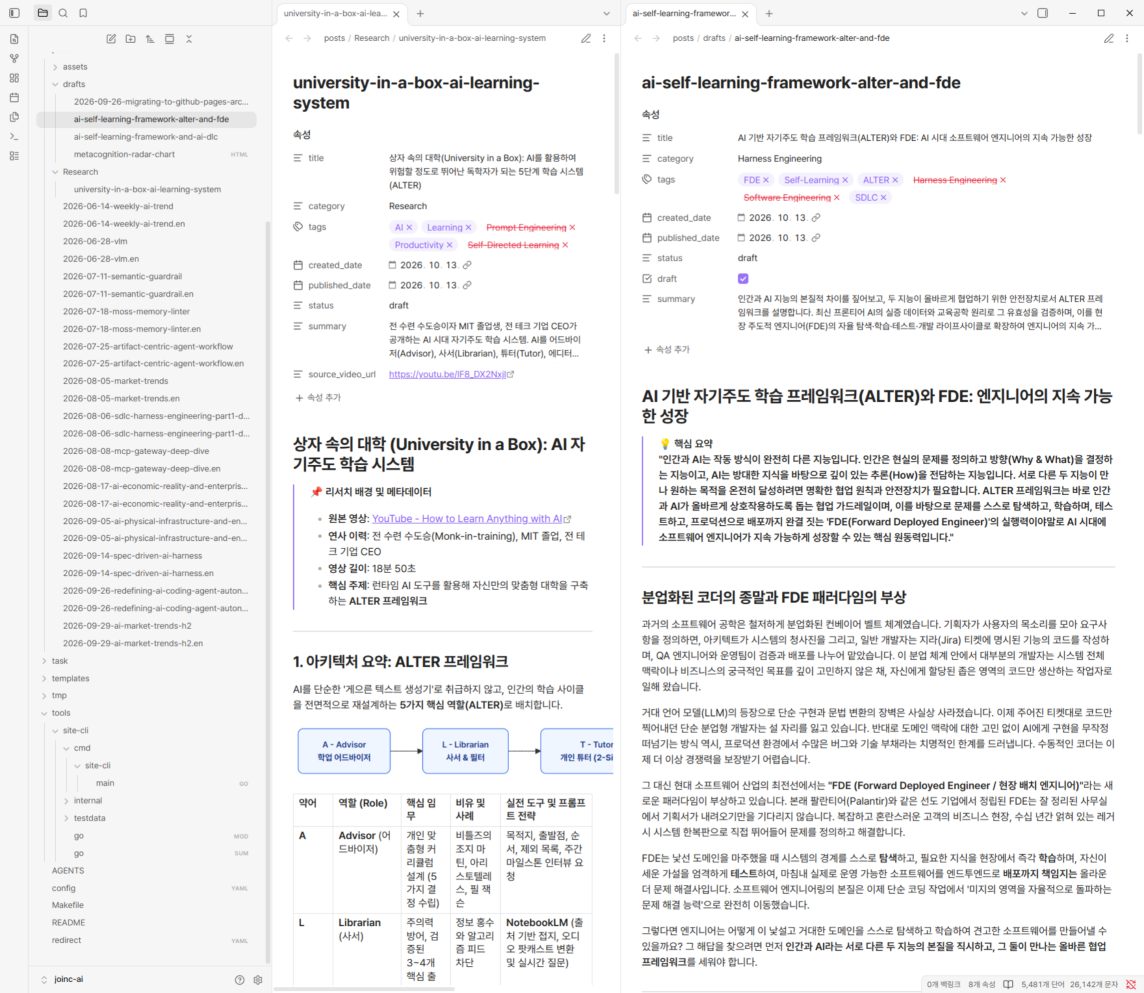
The first screenshot shows my local Knowledge Management System (KMS) powered by Obsidian. As seen in the file explorer on the left, I do not use Obsidian merely for casual note-taking. Distilled research notes from external lectures and papers (Research docs in posts/Research/), iterative manuscripts co-developed with AI (Drafts in posts/drafts/), published articles (Posts in posts/), the Go-based static site generator engine (tools/site-cli/), and the declarative agent protocol (AGENTS.md) are all managed inside a single local Vault (Git repository).
In the center pane, raw research notes from a YouTube lecture are iteratively refined through Socratic dialogue and structural editing with AI into the polished article shown in the right pane—all within a single unified workspace. Because both documentation and source code are version-controlled in GitHub, the entire environment remains portable across any machine.
2. Task Planning & Execution Control via Antigravity CLI and Custom Jira Tooling
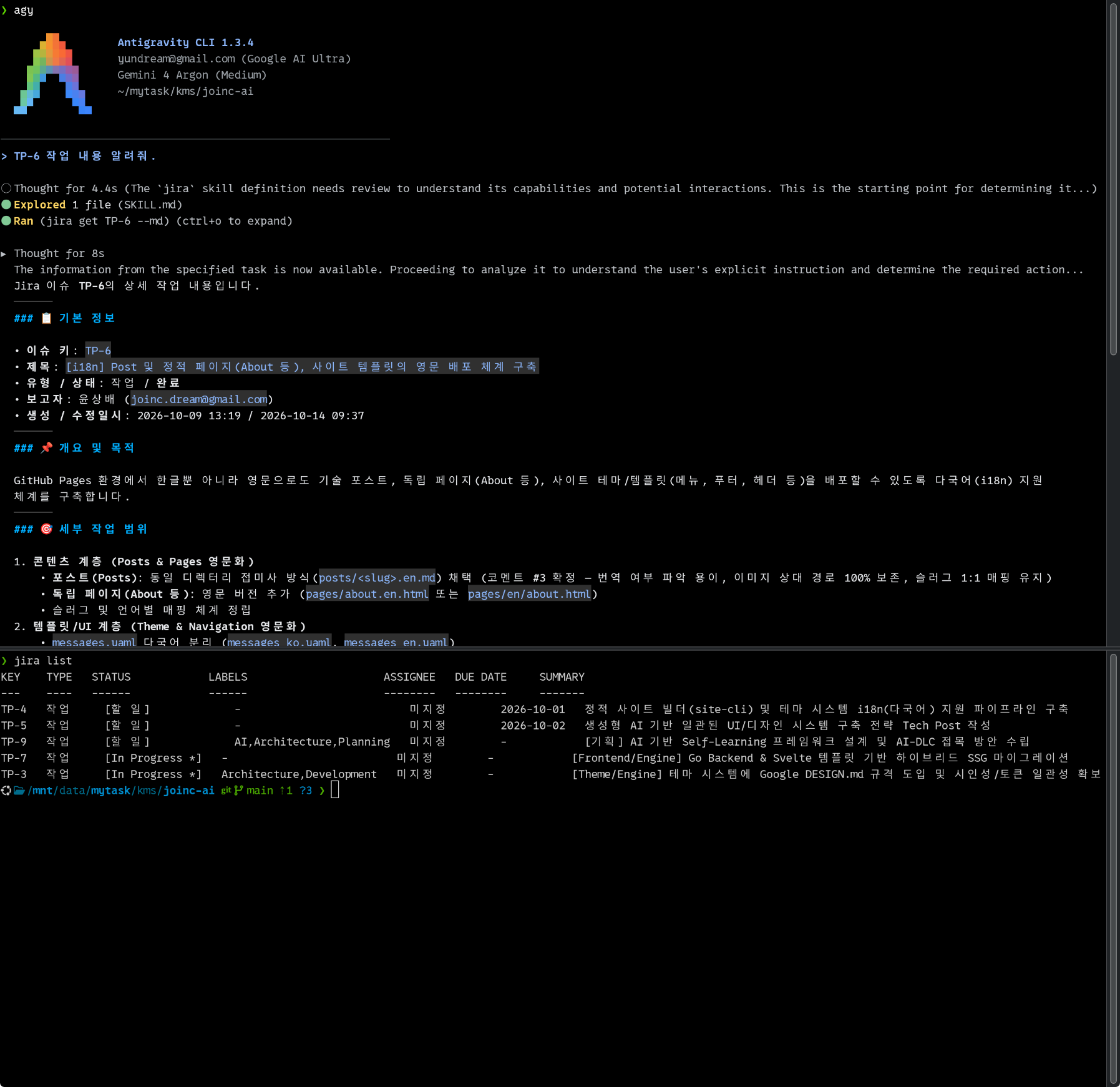
The second screenshot illustrates the Antigravity CLI agent and custom terminal toolchain in action. Using the Markdown documents and OKF architecture specifications stored in my Obsidian Vault as a Single Source of Truth (SSOT), I collaborate with Antigravity CLI in a bidirectional loop where reasoning outputs and code edits are written directly back into the local Vault.
To prevent long-running tasks from drifting off course, I integrated a custom-built jira CLI tool directly into the agent's skill registry (.agents/skills/jira/SKILL.md). As shown in the terminal backlog at the bottom (TP-9: Design AI-based Self-Learning Framework, etc.), I plan sprint tasks alongside the AI agent, inspect ticket context on demand, and track execution against explicit Definitions of Done. Every Jira task artifact links directly back to corresponding documents in the Obsidian Vault, maintaining end-to-end traceability.
In this way, the entire lifecycle—Knowledge Curation (Librarian) ➔ Interactive Drafting & Coding (Tutor) ➔ Deterministic Local Toolchain Verification & Issue Closure (Editor) ➔ Architectural Institutionalization (Roommate)—runs every day on top of this local Obsidian + CLI Agent harness.
Conclusion: The Core Engine of Sustainable Growth for Engineers
Throughout this article, we have established two foundational truths:
- Human and AI intelligence operate on fundamentally different principles, and the ALTER framework provides the practical interaction guardrails needed for these two intelligences to align and achieve complex goals.
- Operationalizing this collaborative protocol on the software engineering frontline yields the FDE Lifecycle—an end-to-end loop of autonomous exploration, domain grounding, interactive implementation, deterministic testing, and architectural evolution.
The takeaway for every practitioner is clear:
"To remain competitive and grow in the AI era, a software engineer must be able to autonomously explore, learn, test, and build end-to-end."
Engineers who passively wait for top-down specifications—or who blindly hand over coding to AI without the domain grounding to judge output quality—will inevitably lose their footing as the industry shifts. The engineers who thrive as primary architects of the future are those who step directly into unfamiliar business domains and complex legacy systems. By wielding AI as a rigorous Advisor, Librarian, Tutor, Editor, and Roommate—and executing with the end-to-end ownership of a Forward Deployed Engineer (FDE)—you build a compounding engine for lifelong technical growth.
No one crosses a river by standing on the riverbank endlessly comparing the specs of passing boats. The only way across is to step aboard and take the oars yourself. The AI-driven self-directed learning framework presented here is more than a study technique; it is the most reliable, actionable engine for software engineers to prove their expertise and sustain long-term growth across the AI paradigm shift.
[Appendix] Practical Metacognitive Self-Assessment Report
[!WARNING] Usage Note (For Practical Reference)
This assessment report is an exploratory exercise designed to visualize qualitative patterns in human-AI interaction. It adapts emerging academic frameworks (SPS, SYNC, Aiming Thinking) that have not yet been standardized into a single universal metric. Treat the scores not as an absolute psychometric measurement, but as a practical diagnostic mirror to objectively audit and improve your own AI collaboration habits.
How This Report Was Generated
As empirical evidence mounts that meaningful engineering outcomes require tight human-AI alignment, the market's definition of AI competency is shifting—from merely knowing how to launch AI tools to how effectively a human directs, questions, and collaborates with AI across complex multi-turn sessions.
In response, researchers in Human-Computer Interaction (HCI) and cognitive science have begun developing evaluation frameworks—most notably the Strategic Prompting Scale (SPS), the SYNC Model, and Aiming Thinking—that analyze multi-turn dialogue logs to determine whether a human user is passively surrendering agency to the model or actively steering it as a cognitive instrument.
In fact, this very article was forged through dozens of intensive, iterative dialogue turns between the author and an AI agent. Upon completing the manuscript, I instructed the AI agent to apply these academic metacognitive evaluation rubrics in reverse—conducting a strict, evidence-based audit of our entire collaborative session.
Here is the exact prompt used to generate the audit:
💬 [Actual Evaluation Prompt Used in Session]
"Audit our entire conversation session from start to finish using an 'AI-Human Metacognitive Collaboration Assessment Framework' and generate a diagnostic report. Across all five dimensions (Goal Setting, Information Verification, Socratic Inquiry, Macro-Structural Editing, and Cross-Disciplinary Synthesis), strictly avoid arbitrary score inflation—you must cite concrete utterances and behavioral evidence observed directly in our session logs."
While these frameworks are still evolving in academia, running this audit serves as a remarkably sharp mirror to check whether you are being passively carried along by fluent AI prose or actively commanding the system as a high-agency engineer. I encourage readers to run this prompt at the end of their own deep work sessions.
The audit results from the authoring session of this post are summarized below:
Quantitative Assessment & Empirical Evidence Across the 5 Pillars
| Assessment Pillar (ALTER Mapping) | Score | Academic Framework Metric | Empirical Behavioral Evidence Observed in Session Logs |
|---|---|---|---|
| ① Goal & Guardrail Setting (Advisor) |
96 | • Planning & Targeting • Objective clarity & boundary control |
• Immediately detected early draft scope drift and realigned the thesis • Injected the guardrail: "Do not restrict the learning framework solely to software coding" • Enforced strict scope control in the FDE section: "Keep the core lifecycle here and defer low-level CI/CD details to a follow-up post" |
| ② Source Verification & Grounding (Librarian) |
94 | • Grounding & Epistemic Calibration • Mitigating mean regression & hallucination |
• Explicitly defined the 4 verification criteria (temporal drift, contextual relativity, 5% near-miss errors, learner readiness) • Formulated the output spectrum model: "Generic AI output is the result of missing human constraints" • Demanded strict fact-checking on whether a critique of shallow generalism reflected documented industry consensus |
| ③ Socratic Metacognition (Tutor) |
98 | • Metacognitive Monitoring • Shattering the Illusion of Competence |
• Connected Plato's Republic (Cephalus counter-example) to design the 3-stage practical tutoring cookbook • Identified the execution gap ("Is self-direction innate?") and resolved it via Vygotsky's scaffolding and psychological safety • Pinpointed the cognitive root of AI alienation ("The hollow feeling that I didn't build it") |
| ④ Macro-Logical & Structural Editing (Editor) |
97 | • Systemic Refinement & Agency • Authorship recovery & telemetry alignment |
• Restructured the entire narrative around the systems engineering principle: "Optimize the whole system before optimizing local components" • Established the film director authorship thesis: "Had you offloaded everything to AI, you couldn't even recognize that the output drifted off target" |
| ⑤ Cross-Disciplinary Pattern Transfer (Roommate) |
99 | • Analogical Leap & Deep Structure • Tacit knowledge & cross-domain synthesis |
• Recalled the historical lesson of Steve Jobs's 10-year Consilience wave (calligraphy & tactile design) • Originated the core analogy: "Reading a few management books doesn't make you a crisis-ready CEO" • Deconstructed personal tacit intuition into three actionable daily training habits for readers |
A 5-Point Self-Assessment Checklist for Engineers
When using AI in your daily coding, architecture design, or technical writing, open your session log and test yourself against these five questions:
- Advisor Check: "Before asking AI to generate code or prose, did I explicitly inject both the ultimate objective and the list of non-goals (what must be excluded)?"
- Librarian Check: "Rather than blindly trusting AI summaries, did I anchor the model's context in verified Single Sources of Truth (SSOT) or official specifications?"
- Tutor Check: "Instead of passively nodding along to fluent AI explanations, did I test boundary conditions like Socrates and reconstruct the mechanism in my own words using the Feynman Technique?"
- Editor Check: "Did I go beyond cosmetic line-editing to audit and steer the macro-structure, causal flow, and architectural integrity of the entire system?"
- Roommate Check: "Did I step outside the silo of my immediate tech stack to explore structural analogies from classic computer science, biology, or other engineering disciplines?"
When you can answer "yes" to all five questions with confidence, you cease to be a passive consumer of AI outputs—and grow into a high-agency creator and Forward Deployed Engineer who commands AI as an extraordinary instrument of engineering mastery.